
Issue 4
Editorial Board
Editor in Chief: Ella Taft
Deputy Editor: Hana Carlson
Editorial Assistants: Chase Agudo, Sarah Duncan, Ana Goyle, F. El Idrissi, Caroline Powers, Evelyn Yang
Accessibility Team
Director of Accessibility: Yusra Khalil
Representative: Julieta Cerda
Representative: Matilda Yiu
Publicity Team
Publicists: Ana Goyle, Sarah Duncan, Juliet Higgins, Ella Taft
Web Design: Ella Taft
Anachronism
Writers
Ella Taft
Hana Carlson
Juliet Higgins
Ana Goyle
Eleonore Mordacq
Julieta Cerda
Lyria Hunte
Yusra Khalil
Matilda Yiu
Caroline Powers
Zoe Cobb
F. El Idrissi
Sophia Z.
Bella Holt
Bernie Ince
Evelyn Yang
Chase Agudo
Sarah Duncan
Aojia Wang
Jaden Lai
Amy Smout
V. Rowny
Noshin Sayira Torsa
Serena St. John
Seoyun “Elsa” Lee
Dennis Taft
Hannah Rhee Kim
Yue Y.
Mia Saira Gyani
Henry Johnston
Sadé Williams
Mishka Suri
Kzreel Pierre
Zoe Friedland
Aicha Benchemsi
January '26
Contents
-
Introduction
-
Shattered Petals: poetry
-
Reflections of Light: personal essays / narrative journalism
-
Corolla's Looking Glass: flash fiction / vignettes
-
Notos and Eurus: literary analysis / criticism
Represented Countries
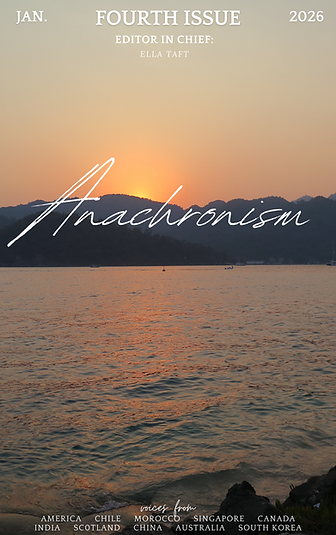
America, India, Chile, Morocco, The United Kingdom, China, Singapore, Canada, South Korea, and Australia
.png)
Photo Credits and Cover Design: Ella Taft
CONTENTS
PERSONAL ESSAYS / NARRATIVE JOURNALISM
INTRODUCTION
A Letter from the Editor in Chief
Dear All,
For those of you who know me well, you are no doubt familiar with my passion for both writing and theatre. It just so happens that my latest show opened two days ago, despite the snow storms up in NYC that forced us to lose considerable time during our tech rehearsals. Though the fun and fantastical Seussical the Musical may not be famous for its efforts to capture daily life and human relationships, I was in a play this fall that did just that. I performed as Eurydice in Sarah Ruhl’s play, Eurydice—a modern adaptation and retelling of the Ancient Greek Orpheus & Eurydice myth. The ruler of the underworld, Hades, owned a skyrise apartment, and the musician Orpheus used a rotary dial phone. I suppose you’ve already made the connection to our fourth issue’s title: anachronism.
The roots of the word anachronism are in Ancient Greek. ἀνά meaning against or back, and χρόνος, time. I know this because it was an extra credit question on a Greek quiz I took a few weeks ago—a question that, thankfully, I knew the answer to. It means something out of place chronologically. It means an error that caused something that clearly belongs to one period of time appear in another. Something outdated. Something that does not belong. That is too futuristic for the time. Or, conversely, that should’ve been left in the past.
‘History repeats itself.’ That was the one phrase I kept hearing as a child, and continue to hear today. History repeats itself. A common saying. One that people say with a shrug, or with a very upset tone. The people who say this phrase wish the phenomenon would stop, but none of them really take much action to stop the repetition of history. Action is terrifying, sometimes. Understandably so. But this team of GLS writers is here to show you that action doesn’t have to be dramatic or dangerous. Sometimes, just using your voice at all is enough. Sometimes, not allowing yourself to be silenced in a time of silencing will make all the difference.
My school took a few students to see the musical Ragtime on Broadway earlier this year, a show set in the early twentieth century, and it was shocking to stare into a mirror of our present day. Our past haunts us. History repeats itself. Anachronism.
In this issue, we bridge gaps across time. We support each other—young students living, resilient in the face of adversity—and we publish our narratives, unashamed. I hope this issue gives you inspiration and hope. I hope it pushes you to take action. And I hope you enjoy every minute of it. Congratulations to all of our writers.
Sincerely,
Ella Taft
Editor in Chief
Founder of GLS
SHATTERED PETALS
Poetry
Reflected in the Eye of a Falcon
BY HENRY JOHNSTON
A swath of white and twigs,
winding paths,
and a piercing blue pond.
channels of murky blue and pale floes flash by on either side.
The eye blinks against cold angels,
descending from the heavens,
to assail the city below.
Their tiny crystal spears crash home against steel and glass.
Beneath baby blue suede and tawny soles,
spears shatter.
Above a steaming paper cup and beside flushed cheeks
spears liquify.
headphones perched snuggly over his ears,
His world is accents on the one and three,
crunchy distortion,
and an eclectic blend of an indie melody and delta intones.
Tan winter coat hugging his shoulders,
he walks south.
Cup still steaming, he stops and takes a sip,
stamping his feet to ward off the cold.
Hands thrust into his pockets,
the gloved fingers of his right hand fidget with a guitar pick.
He’s just a speck in a wide world,
Twirling plastic with frozen fingers.

dream / space
BY EVELYN YANG
lemonade quenches weepy spirits
from dulled paper planes
burn under moons off far away
metal junk glaze and
comet toppings
breath in lingering gas remains
they’ve all forgotten sweet
fresh tart
lemonade but settle for powder
to replace
a youth of grounded gravity
and a darkened cave
sleepy breeze rolling gently down
a beaming face
yet entrapted in sickness
and stasis of change
tears dreams into reality
again.
Witness of the times
BY ANONYMOUS
He used to sit and write a letter slow,
The ink was real, the waiting long.
Today, the messages all quickly flow,
A different sound, a faster song.
His friends are gone
The world he knew has slipped away.
He is the last one left here alone,
A man survived yesterday.
He watches them speak of things unknown,
Of 'apps' and 'clouds' and sudden 'feeds'.
He walks a path where seeds are sown
To meet a world of modern needs.
He cannot follow this new pace,
His mind is tired, the light too bright.
He is simply out of time and place,
An anachronism in the light.
He sits and thinks of faces lost,
That is the only life he shares.
He knows the future paid a cost,
And left him standing, unaware.
Muse #2
BY NOSHIN SAYIRA
And when i watch kids utter the language we
once spoke
my heart breaks.
I feel the letters imprinting themselves on me,
as i now no longer have the ability to say them.
When our tongues were entangled, it was more than sexual.
It was sensual. Languages across the world meant nothing,
as all was already being told.
'Uhibuki Hulmi
I don't know where you are anymore,
ana huna dayi’man
or what you do, even if once I was
your life plan.
'afeal la maenaa laha bidunik
I am so sorry.
‘ana aasf ayDan
When my exhaustion drugs me, I see me and you walking into forevermore.
Translation
'Uhibuki Hulmi: I love you, my dream
ana huna dayi’man: I am always with you
'afeal la maenaa laha bidunik: Meaningless actions without you
'ana aasf ayDan: I am sorry too
Untitled
BY MIA GYANI
Silence.
Our mouths taped shut
By the desperate hands of the authorities
Our voices
Shouts, to mutters, to whispers,
To silence
They are scared
Scared we will spill their dirty secrets
Their hidden lies and buried truths
Because they know what will happen if we do
Protests, riots, wars
Silenced, speechless, and torn
Yet through the chaos and oppression
A revolution
Is born
Triolets on the drive home
BY ELLA TAFT
How will the bird know when to fly?
We’re taught to fly away from cold.
That time of year, life dulls the sky,
How will the bird know when to fly?
Do they all know what waits for them,
Or blindly follow the wind—
How will the bird know when to fly?
We’re taught to fly away from cold.
Do traffic lights shine more at night?
They blind the owls, hunting prey.
The tears are dull throughout the day,
So traffic lights shine more at night?
Just me and him, and red too bright,
The road, the mouse, our two delights,
Do traffic lights shine more at night?
They blind the owls, hunting prey.
Memories from the Kitchen
BY ANA GOYLE
I clutch her skirt next to the fiery stove,
her trembling fingers knead stories in dough
and lentils, yellow, simmer in the pot;
old grief moves slowly through the kitchen air
Her trembling fingers knead stories in dough
as she softly murmurs wisps of dying prayers
old grief moves slowly through the kitchen air
and her laughter sounds of fallen, shattered plates
As she softly murmurs wisps of dying prayers,
a needle pulls on thread and ties us one
and her laughter sounds of fallen, shattered plates—
With her memory fraying slightly at the seams
A needle pulls on thread and ties us one
and lentils, yellow, simmer in the pot
With her memory fraying slightly at the seams…
I clutch her skirt next to the fiery stove.
leaning tower of piss
BY CHASE AARON AGUDO
“our days are but a flickering nuisance
in the limelight of love..."
is some bulls**t i’d say
if only i’d someone to say it to
“listen here, jack,”
(this is the part where we lean in)
“these girls nowadays are a dime-a-doz’n.
the second she gives ya’ trouble,
kick ‘er off to the curb,
an’ don’t let ‘er come back!”
that’s great and all,
we’d say,
only that’s terrible advice,
and neither of our names is jack.
“pah! suit yer’self!”
spits the tower of dust.
(his breath smells just like stale coffee
and his nose hairs hang at his feet)
“damn’d fool,”
the old man croaks,
“back in my day…”
and scene.
Fate
BY AOJIA WANG
I am the cruelest thing you’ll ever meet
The most disgusting, isn’t that right?
I grip your wrists, your trembling fingers
And intertwine with all my might
I place a sharp and painful kiss
My nails dig deep through flesh and bone
I tie you up with crimson wire
And spin and spin, ‘till not alone
I think of ways to make you suffer
Your pain is all I know and feel
I sew the guilt into your veins
And whisper until it makes you ill
Yes, I am just that evil
All I do is just for fun
Fate is the cruelest thing,
I am the cruelest one
Nothing hurts when you are hurting
It's my fault that you’re in pain
I can think of nothing else,
I learned your words until they stained
I would wish to be a person
Just to live with no strings attached
You needed someone left to blame
I will be your one true match
Everything hurts when you hate me
I wish I were kind to you
I only smile, I cannot cry,
What else was I supposed to do?
Yes, I am just the reason
All I do is for your pain
What else could I possibly be?
I am just fate, I am both love and hate
These broken strings are all that I have,
The only proof I was living.
Home, Alone
BY ANONYMOUS
These ribbons got all mixed up with twine
(Detangling means pretending all is well),
Moving out, I no longer know what’s mine.
Framed pictures on the wall would never align,
It’s a miracle none of them ever fell,
But these ribbons got all mixed up with twine.
The hours spent under a light that wouldn’t shine
Hearing stories that now I am trusted to tell,
Still, moving out, I no longer know what’s mine.
Siblings guests believe get along just fine—
They gave their parents years of living hell—
And these ribbons got all mixed up with twine.
I do not wish the walls to watch my decline,
As I spend my years suffocating in this shell,
So, moving out, I no longer know what’s mine.
I curse my dampened skin, unmistakably brine,
When deciding what to keep, what to sell.
These ribbons got all mixed up with twine—
Moving out, I no longer know what’s mine.
Eclipsed
BY NOSHIN SAYIRA
The Moon only glows
when the Sun permits it.
Light becomes the innocent hands that you lift close
just to plot your demise.
Hope keeps slipping
through the sieve of my palms. A souvenir abandoned
from every trip.
A film I pause
before the ending.
A plane I search for,
but never buy the ticket to,
almost always boarding.
You return to me in my
feverish dreams,
unfinished novels,
erased definitions,
eyes gone cynical.
You spark something
in my hollow self,
then you open your mouth and blow it out.
You catch my falling body
just to step away
at the last second.
And yet, I yearn:
I still yearn for you,
the way a bandage
slowly loosens and
lets go of the wound
knowing it will bleed again.
Sailor to Sea (Rondeau)
BY ANONYMOUS
If a performer takes a bow, all life gone away,
If the kiln fails to fire and all is just clay,
If the castles last a childhood, before it’s back to sand,
And you have your posters, but forget your favorite band,
And we stopped building forts, we just don’t know the day;
All fabrics, faded for fear of judgement, gray,
When theatre—a world—becomes just a play,
Forget folds of cat's cradle upon our own hand;
I mourn the slip of life too young for rebirth.
All those times of can corrected to may,
Gumballs at the corner, all we had to pay,
As sailors, we stop recognizing our land,
We stumble and fall when trying to stand,
And mumble and mutter when trying to pray.
I mourn the slip of life too young for rebirth.
A Girl for the Misogynistic Newspaper
BY F. EL IDRISSI
Define being a ‘girls girl’—
Explain the term you so desperately want alongside your name when someone is describing you.
The truth is,
you’re the most shitty, deceiving bundle of bruised kindness that wouldn’t hesitate to stab the person who loved you in the back again, and again, and again, and again with the same pointy marshmallow stick you offered them; intoxicatingly sweet and warm—
On a camp holiday,
When you were both young and innocent…
At least one of you was.
What changed?
Was there a coding error?
Perhaps you always were the way you are,
And I just barely noticed the difference.
The difference between seven years ago and today—
where instead of time standing in seconds, memories become a before and your future becomes an after.
Dear Nostalgia is just one, juicy grape.
One that can rot and dry out of life,
With a slight chance of aging to be part of some bitter wine mix awaiting to be drunk by a specific crowd;
The people you deem worthy of your presence,
by altering just how special you are.
Manipulating everybody you want the attention of,
Yearning for the attention you used to receive when you were that ‘cool’ role model…
So tell me, creature—
Are you satisfied with the attention? With how your insecurities bloomed into your unique beauty; surrounded by men who want you and women who you think envy you—
But we don’t.
We grieve the person you used to be.
Or I guess, the person we thought you used to be.
The person who claimed to prefer the company of her girls,
Is the same person who decided that one who genuinely looked up to her was a dirty little liar.
The same person who started false rumors about one of their closest friends cheating in an official exam.
The same person who would congratulate you on an award, then insult you by saying you were stupid and that all you had was hard work and dedication.
The same person who would say she loves your vibe, but then say that you’re absolutely capable of being a thief right when you have your back to her.
The same person who would cuddle you close, then distance you away from her just because having an ‘anti-social weirdo’ as she falsely defined, as a best friend would not fit with the sculpture she’s trying to create not for— but of herself.
Let us just say,
The shoe doesn’t fit, love.
It’s too small.
Too small for a person with such audacity and pride.
Just who the hell do you think you are?
Who are you in your head?
Who are you in your heart?
Who are you deep down under all of those harmful, judgmental comments and lies?
Own your title, they said.
Well let’s just say,
you sure did, bitch.
Untitled (2)
BY MIA GYANI
I want to write.
I want to write about everything.
About everything I see, I do, I hear
About all of my emotions and all of my fears.
I want to write about the trees, the clouds, and the stars,
I want to write about oceans and what could be ours.
I want to write surrounded by darkness.
About humanity, and what has been forgotten.
I want to write something beautiful, I want to write
something new,
But instead I always end up writing about you.
tiptoeing towards nirvana
BY CHASE AARON AGUDO
And as the sun whispers its last hurrah
while the world goes to s**t
I am tempted to call the whole thing off,
let my legs rest a bit.
Remember how they had told us:
“insofar as we conquer mars
and our progression climbs ever upwards
so too will our humanity endure…”
—and then sunk us all under?
but as the atom bomb explodes
a couple cries their last goodbyes;
the dead snuggle in their coffins;
my mother sings a lullaby
even they, the meek of mankind
understood the meaning of the middle:
for to cry too much
is better than crying much too little.
REFLECTIONS OF LIGHT
Personal Essays / Journalism
Have Hollywood’s priorities shifted from creative to financial?
BY AMY SMOUT
In 2024, nine out of the top ten films were franchise instalments or sequels. Studios back the formulaic projects that ensure a profit margin, while unique and exciting ideas are left on the drawing board. Audiences no longer possess the incentive to watch the seventh film in a franchise. At one point, mid-budget passion projects drove creativity and originality through the box office,allowing up-and-coming directors, writers, actors and producers to shine. Now, the creative spark is being exploited for profit, and the artistic minds behind fan-favourite franchises are feeling burnt out and left behind. It took 148 days of strike for the studios to listen to the names behind these films. As a result, properly funded new ideas like Oppenheimer were received with great enthusiasm by audiences. This was reflected in the numbers: Oppenheimer grossed $1 billion with a budget of $100 million. Sequels and spin-offs satisfy the fans, old stories are reimagined with the latest technology, and studios turn profits like never before. How is this an issue? Film is a place for people to showcase their love for storytelling and new ideas; it shouldn’t be a few hours of video reduced to a singular sum of money.
In Hollywood today, a growing issue among newer projects is the decline of originality and the onslaught of reboots and sequels. Streaming services buy into the formulaic, predictable format and seem allergic to the riskier approach to film. Netflix cancelled multiple shows and film series, all of which had viewers watching and actively engaging. Shadow and Bone (based on the books by Leigh Bardugo) was hugely popular when released, with Season 1 watched by 55 million households in 28 days. Yet they cancelled the series and its spin-off midway through shooting. The reasoning? Shadow and Bone wasn’t turning a sufficient profit margin, despite its huge popularity. This shows how quickly a project is disregarded when it isn’t performing financially. Furthermore, it's not just streaming services that make these ill-advised decisions based on profit margins. Warner Bros. started shooting Batgirl in 2021, and the $90 million film had been in post-production when it was shelved due to cost-cutting schemes, drawing backlash. Test screening didn’t go well for Warners Bros, and they decided to spend an extra $8 million in post-production simply to bring it up to “standard,” exhibiting how studios view films as a budget to be spent, not projects to be refined. If this was the fate of a big-budget franchise film, how many other projects have been shelved simply due to budget constraints from studios?
Furthermore, the familiar names behind popular films and songs feel cast aside. Directors, actors, writers and producers struggle because their industry prioritises content output over artistry. Ed Brubaker, the creator of the “Winter Soldier” storyline, received Marvel’s $5,000 “thank you note” from the revenue of several hit films. Also, in 2021, Scarlet Johansson sued Disney for releasing Black Widow, her first and last standalone movie, on streaming. Johansson claimed a breach of contract and stated that she wouldn’t receive any fees from the movie’s streams. The reason for this breach? The film was doing poorly at the box office, so Disney decided to stream it instead. Disney responded to the lawsuit by revealing Johansson’s upfront payment of $20 million, shifting the blame and labelling her issue as a ‘first world problem’. They eventually settled, but Johansson refused to work with Disney again because of their actions. This demonstrates just how willing studios are to revolve around finances. And there’s still doubt about where their priorities lie?
Films used to be art pieces, and mid-budget films saw upcoming writers, performers and directors shine. But today, studios almost exclusively fund blockbuster franchises or tiny indies, leaving the passion-driven middle ground to fade away. Mid-budget films no longer guarantee safe returns, and studios now favour tentpole franchises (Marvel, Star Wars, DC, etc) or micro-budget streaming. This eliminates the creative risk-taking of film and paints the art more as a financial pursuit. From May 2nd to September 27th 2023, the WGA went on strike over pay disputes. By the time it ended, the film industry lost a whopping $6.5 billion, and the studios had given in. The strikes highlighted studios' short seasons and tight schedules for media that sucked all creativity out of projects. Strikes also exposed just how reliant the studios were on actors, directors, and writers. It also set the stage for a more progressive era of film in the future. Studios are beginning to change, but the absence of the mid-budget films for so long spoke volumes about the priorities of the people with money, and the strikes only exposed them to the public.
Despite it all, studios do give methods behind their logic and provide reasons for the shift of focus to financials. James McMahon argues that global audiences make studios simplify their films to appeal to the majority of viewers. He argues that the formulaic setting is more about managing risk and doesn’t directly kill creativity, but the strikes suggest otherwise. In his article, he says that “in an age of billion-dollar survival, a failed blockbuster can sink a studio.” The cost of making a film is rising, and in an era like now, where global finances can shift overnight, a reliance on profit is understandable. However, it’s exactly this reliance on safe blockbusters that kills the passion in movies, as they get so abnormally repetitive. The methodical approach reduces films to a number while ignoring their other qualities. This is exactly why primarily considering financial aspects kills passion. Hollywood’s calculated safety is exactly what drains creativity, and fans are leaving the cinema with déjà vu instead of feeling.
In recent years, it is clear Hollywood has prioritised the finances of a film over its creative spark . Movie stars have walked out on huge corporations, as their only concern was profits. Detrimental comments have been directed at core franchise stars over financial disputes. An original, well-loved, developing saga was cancelled simply because it wasn’t turning out the required sum. Only extensive striking got the studios to listen, halting production of many anticipated instalments. And there’s still doubt? Studios only see films in numbers, and it’s time we as audiences demand more rarities like Oppenheimer. Who knows, they might actually listen.
Dirty Truth
BY NOSHIN SAYIRA
How does a girl protect herself from a world of crocodiles waiting with their mouths open, ready to tear off her clothes? How does a girl protect herself from a world of parrots mimicking what she says, all because they don't believe it? How does a girl protect herself from a world of owls turning their heads, keeping their eyes on her?
I fear this world.
I love lying. I have been lying since I was four. It has gone from lying about who ate the cookie to who smoked the blunt. And as much as I tell the truth about others to their faces, I often don't tell the truth about myself. But I promise, here is my truth. It's only up to you to believe it.
I will never be ashamed of lying. I will lie until my soul runs out of fire to burn with. But I don't lie to be a villain, or to be evil. I lie to protect myself, to keep my life private. I hate being on speaker. It’s the one thing I will try my best to stay away from. I hate the image of people sitting with smiles and having my name pour out of their mouth, the letters of my name out in the air. I don't want to just not be talked badly about, I don't want to be talked nicely about either. I simply don’t want to exist until I feel like making my life solid. And so I keep it all to myself.
Once I tried honesty. I let my life be out there. I chose words that don't need to be carefully put together, just words from my heart. I gave little pieces of myself to others. I hoped that they would take these pieces and let them stand for themselves. But the world is cruel: they
took my pieces, bent them, burned them, and formed something completely new out of what I offered. I cannot stare at this version of myself without having an existential crisis, because who is she?
Maybe your friend asking “how is your day?” isn't as heavy as CPS asking “do your parents hit you?” But each word that comes out of your mouth is a choice made by your brain, and your brain is who you are. And maybe lying to simple questions is dramatic, and maybe I'm being paranoid, but I don't have the privilege to forget these kinds of things. When I was homeschooled, one of my teachers told me that there are three categories of people, the lowest are the ones who talk about others, the middle are the ones who talk about their past, and the highest are the ones who talk about their future. I never really paid attention to what happened in class, but the only reason I remember this quote is because I vividly remember him talking badly about his wife to me a few days after that. That's when I realized that just about everyone belongs on that low level.
How do you expect me to talk about myself when I know someone else is going to as well? Every lie is a choice. My story is not to be handed over to others to be copied or molded. It's my voice, my experience, my personality, mine, mine, mine. Do you really want yourself, something that's carefully made and loved, to be changed by others? Do you really want the good in your life to be shown in a spotlight, just for people to say “that’s so amazing” and then go home and down a bottle and black out? Attention is disgusting, and it's a force that does not live in a vacuum. Attention invites chaos. Once people are looking, things are happening. Attention is a parasite, it will eat and eat until it ruins you, until all the meaning is gone and you sit with time by yourself.
When people ask me why I chose to come to Stuyvesant after being homeschooled, I just say “I don't think that place was meant for me.” It’s an easy answer, because whatever's meant to be will happen. But it's nothing personal. I can't say all the things that happened behind closed doors and in cars, all the hands and all the shows, all the “why’s?” and “please no’s.” I let them know nothing, because I don't want those dumb pity eyes or the dramatic police cases. I protect myself and my entire community in one sentence. Homeschooling wasn't meant for me, but not in the way where I’m meant to be some ambitious college-driven kid, but one where I’m supposed to be able to go to school and be okay.
Sometimes I think about telling the truth. Letting all the things I’ve hidden spill out until the air becomes suffocating. Say it all with a smile, and act like I haven't spent the past years of my life hiding as an act of protection. And then I see people's mouths laughing at me, or stares that dig into my soul. I see my name on posts, or on notes being passed. I see all this in the nightmares I don't ask for. And that's how I know not to.
When the question of morality comes to play, I have to leave the conversation. I don't believe lying is great either, but if they don't want me to lie, why do they make it so necessary? Is lying really an issue when I want to stay mysterious? It's a vision of myself I have in my head that cannot disappear regardless of whether you wish it to.
Lying is ugly, I know, but so is this world. I’m not here trying to act pure for you; I’m trying to keep myself alive. If twisting the truth is what I need to do to survive, then I’ll twist. I’ll break my fingers before I shatter the image I curated for myself. Lying or protecting, whichever you think it is, it's mine.
I wonder how you feel about reading this essay. Do you believe me? I’m not sure if I believe myself either. I’m disgusted by my own actions, but I don't know how to live in this world otherwise. All the lies build up, and form their own version of themselves. When I sleep at night I see those lies as a person. They ask me why they've been born, and I throw up.
COROLLA'S LOOKING GLASS
Flash Fiction / Vignettes
Masks on Main Street
BY SADÉ WILLIAMS
Halloween comes once a year, but I see costumes every day.
They walk down Main Street — the man in his new navy-blue Epstein & Parker suit, hoping the right fabric might earn him a promotion; the woman in her fresh pair of Louis Vuittons, craving not comfort but acknowledgment. Their wardrobes are stitched from fear — fear of being unheard, unseen, unimportant.
We pretend our costumes end with October, but the truth is more chilling. The masks linger, sewn tightly to our faces by expectation and ego. We trade authenticity for approval, speaking through voices polished to please. We silence the raw, trembling sound beneath — the one that dares to be real.
They say Halloween is about pretending to be someone you’re not. But what if it’s the only night we’re honest about it? The only night we admit that we’ve all been dressing up long before the candy bowls and fake cobwebs appeared.
The true horror isn’t in the creatures or ghosts. It’s in the quiet realization that the scariest costume of all is the one we never take off.
NOTUS AND EURUS
Literary Analysis / Criticism
Power and Pupil
BY AICHA BENCHEMSI
To be blinded takes on both a literal sense, as well as a metaphorical one. People can be blinded by ambition, denial, or hope. Ultimately however, limited vision is often seen as loss of control, while sight is a form of power. This idea is evoked in Scott Fitzgerald's novel The Great Gatsby and Margaret Atwood's novel, The Handmaid's Tale. While in The Great Gatsby, vision is deformed and instrumentalized in order to fit illusionary fantasies, in The Handmaid's Tale, sight, despite remaining unreliable at times, is presented as a dangerous form of power, threatening the positions of those who already wield it. Across both works, constant surveillance and judgment is used to remind characters of their subordination to greater forces.
In The Handmaid's Tale, characters live under constant surveillance, stifling their freedom and creating a feeling of distrust and weariness. This surveillance is most clearly demonstrated by the devices put in place by Gilead's oppressive regime in order to keep the population in line. Spies of the regime are called “Eyes”, and Offred often comments on their omnipresence leading her to question the intentions of other characters. She wonders if Nick is a spy for the regime, and if the tour guide is watching to see if Ofglen and her slip up when asked questions. The symbolism of this title is used to create a sense of unease, Gilead is “crawling with eyes”, ready to exact punishment at the slightest hint of non-conformity or resistance to its imposed ideology. In addition to literal surveillance, characters are subjected to and reminded of divine surveillance or judgment on a daily basis. The standard daily greeting in Gilead is “Under his eye”, reflecting the notion of an all-seeing, masculine, God. The choice of the word “under”, reminds characters of their complete subordination and lack of power compared to the judgment of this divine entity. The use of sight imagery to represent both divine and governmental surveillance in Gilead reinforces the idea that vision is closely tied to power.
Similarly, in The Great Gatsby, characters are subject to constant judgment, whether divine societal, or by other characters. Firstly, the symbol of the Eyes of TJ Eckleberg play an important role in establishing a sense of surveillance and judgment. Much like in The Handmaid’s Tale, the symbol of an eye refers to divine judgment. It is important to note that the Eyes of Eckleburg reside on a billboard high above the ground, making it so that they look down on the characters. This goes hand in hand with the fact that the people of Gilead are “under” God's watch, a reminder of our submission to divine will, and of our own lack of power. In addition to divine judgment, these Eyes are a symbol of societal judgment, and the power of strict social codes and norms. Another example of this is the gossip surrounding Gatsby, and the ways that the guests at his parties judge and perceive him behind his back. These guests speculate about how Gatsby came to gain his affluence, saying he is surely a boot legger, thereby tainting his image and representing the greater weight of societal judgment when wealth doesn't come from the traditional elite upper class. Beyond mere bootlegging accusations, people exchange more and more outrageous theories about his origins, with statements such as “I heard he killed a man” and a rumor that Gatsby is “second cousin to the devil”. Through indirect characterization, Fitzgerald reminds the reader that even those who seem as though they should hold great power are subject to judgment, putting forth the idea that when watched and judged by a collective, individual power is diminished.
Ultimately, The Great Gatsby and The Handmaid’s Tale both expose vision as a double-edged force: to see is to judge, and to be seen is to be controlled. In Fitzgerald’s novel, sight is distorted and exploited to sustain illusion, characters project fantasies onto others, blinding themselves to truth in pursuit of desire, status, or hope. In Atwood’s dystopia, however, vision is weaponized more overtly; surveillance becomes an explicit tool of domination, and the mere possibility of being seen is enough to enforce obedience. Despite these differences, both texts converge on the same unsettling truth: limited vision signals powerlessness, while those who claim the right to watch assert authority over others. On a broader level, both novels warn of the human cost of surrendering perception, reminding readers that when sight is monopolized by dominant forces, autonomy erodes, and individuals become complicit in their own subordination.