REFLECTIONS OF LIGHT
Personal Essays / Narrative Journalism
ISSUE ONE: (1) The literary device orange, (2) Aren't you glad? (3) Hot Take of the Issue: In Defense of Modern Art, (4) To all those writing history papers, (5) The Sixth Grade Trial
ISSUE TWO: (1) You’re Looking for a Cute Genre… But It Ain’t Me, Babe
ISSUE THREE: (1) restful chaos, (2) Everyone Has a Time, (3) hide and seek
ISSUE FOUR: (1) Have Hollywood's priorities shifted?, (2) Dirty Truth
ISSUE FIVE: (1) What Makes Sex Good? (2) hollow throat
ISSUE SIX: (1) Ode to New York City
ISSUE SEVEN: (1) i think, (2) An Ode to Bad Hair Days
ISSUE EIGHT: Coming soon!
The literary device orange
BY EVELYN YANG
According to social media, the use of oranges as a metaphor, metonymy, imagery, a literary device, is overdone. That once a writer reuses and recreates what was already created before, it is useless and meaningless. The juices of an orange, the walls which separate the slices, the citrus scent which sticks underneath your fingernails– cannot be used uniquely again. I agree, because of course everyone already knows of an individual’s inherently poetic and beautiful connection to a mere fruit.
Of course, everyone will know that oranges, fruit, is an expression of love I can barely accept. Of the meticulously peeled and cut slices of apples, melons, and mangoes that my parents used to set on a plate in front of me when I was child. The fruits which were chewed and swallowed hesitantly, tumbling down my throat with jagged edges. My throat would itch, mouth would tingle, lips would swell, as soon as I choked down their apology. As if I could sense the insincerity, the belief of righteousness, the shame. It is common sense that instead of apologies and loving touches, I have orange slices offered in the small space of a car, amidst the lingering of my frustration.
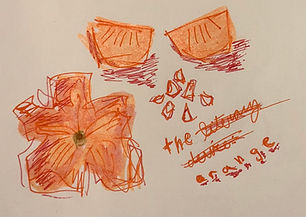
Art credits: Evelyn Yang
And it’s only right that they’ll know the scent of my perfume– the dragon fruit layered with orange blossom. The memory of plucking it randomly from a shelf at the end of summer, asking my friend if it smelled good. Being convinced to buy it and wearing it for the remainder of the smoky summer. Spraying it on while in the trenches of winter and bleakness; having the same friend turn to me with a smile and ask if I’m wearing the perfume “from the summer?” Smiling in return, and sharing a brief respite with my friend, visualizing the return of shorts and the sharp scent of sunscreen.
For the orange experience is universal, everyone knows the thrumming fear of accidentally swallowing an orange seed, and the sudden love for oranges that causes you to eat two, then three, then four. The stupid—and likely useless—hack of rolling an orange before peeling, as if detaching skin from bone through consistent movement. Plunging your thumb into the bottom of the orange, and tearing uneven strips until the rind detaches from the meat of the fruit, curling into a flower. Hearing a rumor in fourth grade that your old crush once ate an entire orange peel. Gently splitting the pre-divided slices, the whole unwinding like a clock. Going through phases of eating oranges like a habit, to the loss of its taste on your tongue.
So the consensus is that it’s too everyday to be notable, an orange. How pointless it is to be one, torn apart and never put back together. Nothing of importance, not enough to apply to a writer’s deep and unexplainable life experiences. An orange is simply a fruit of disappointment, tossed from writer to writer. Everyone knows that, don’t they?
Aren't you glad?
BY SARAH DUNCAN
To the elderly couple who lives across from Prospect Park, just be glad your apartment is rent stabilized. You should be set to live there for as long as you like, and grow old alongside your refrigerator and stove. There’s no need for the superintendent to renovate, he’ll take care of it once you leave, which won’t be for some time, right? He knows that letting your appliances deteriorate keeps you in checkmate, for there will be too great of a cost for any move you two could make. This is when you two must resign the game and know your king has been defeated, and it will rest on the board without having been touched though knowing that there were risks in every direction. Not to worry, your vintage apartment is pretty cool to anyone who has newly moved into your building and comes over to visit, although you may feel stuck in time when you go over to visit theirs. But at least you may remain frozen in time instead of coping with the price of moving forward.
And to my cousin, who has lived in the Crown Heights and Flatbush area for the nearly 20 years she’s been in New York, was the cultural shift at your train station the first sign? Has the lively community which reminds you of your island home been what compelled you to stay, because the soursop ice cream tastes like the ticket away from this concrete jungle? Make sure to tone down the steel pans and fetes on Labor Day: what sounds to you like community sounds drives others to file a noise complaint. And if any young, new resident tries to bar you from entering a family member’s building, assuming you could not possibly live in what they believe to be their neighborhood, empathize. It was a valid mistake on behalf of someone ignorant to the predominantly Caribbean demographic of their neighborhood. For they’ve only known the high rise buildings, while you still smell the spice from the roti shop that stood there long before.
And to my father, who lived in our Harlem brownstone 25 years before we moved in, aren’t you glad to see your old neighborhood less impoverished? You’ve tasted Harlem in two different forms, and yet you find the rusty reputation to be the most flavorful. Sacrifices must often be made in the name of progress. Now I no longer have to travel to the Upper West Side to find Trader Joes or Sephora, though they line the historic street where natural hair supply stores and soul food used to be. What good is it holding onto the past when progression forces you forward? What good is holding onto the culture disregarded in order to invite others in, and force you out?
And to the long standing or previous residents of Nostrand Ave, aren’t you glad there’s a Starbucks in your neighborhood? You no longer have to rely on the quaint Haitian bakery for the warm, fresh bread rolls as a morning treat, now you may find green juice and franchised coffee on every corner. Why do you shake your head and sigh? When I was 8 years old, I so desperately wanted to try a Starbucks frappuccino. Not only was I too young to drink coffee, I also only found Starbucks in the neighborhoods I cannot afford. I quite like frappuccinos; they are the sweet, chilling taste of the teenage girl I wanted to be. But I’ve come to prefer black coffee and besides, everyone has moved onto strawberry acai. On every one of my infrequent returns to this unfamiliar street, and its unwelcoming stench of commonality, I will search for the aroma of beef patties. Only then will I know I am still welcome home.
Hot Take of the Issue: In Defense of Modern Art
BY BELLA HOLT
If you own a TikTok account, you may have seen a trend in which people stand next to modern or contemporary artworks with the text reading something along the lines of “standing next to art we could’ve made”. In recent years, this scorn of modern art is widely acknowledged on social media; “modern art is not real art”, some say, and others, “BRING BACK RENAISSANCE ART”. Although the fact that these opinions are being expressed is perfectly reasonable, I believe that many of these arguments lack depth by overlooking the basis on which it is made.
Modern art, according to visual arts teacher Emily Valenza, is art made “anywhere from the 1860s to the 1970s, [starting] with the proliferation of photography and the camera. When cameras and film photography were readily available for people to use… [art] went from recording to expressing.” Movements such as expressionism worked to convey the story and emotion of an art piece. Meanwhile, impressionism went against the tradition of invisible brushstrokes, and dadaism rejected the presumption that an art piece should have meaning at all. Minimalism, the art movement that is most often criticized in these tiktoks, uses basic geometric shapes and blocky colors applied seamlessly to explore color relationships, and often, human experiences.
Talia Ziblatt argues that minimalism “is lazy [because] you can give meaning to anything. It’s not interesting to look at, and it’s just the same materials over and over again.” The supposed easiness of making minimalism often makes minimalist art seem unworthy of being in museums, especially due to the assumption that museums are prestigious and only for those who have studied art for years. If you happen to agree with this belief, I ask you the following question: why should the value of artworks be measured by the standards of technical skill set by art that captures reality in a traditional way?
“Faraway Love” is a painting by minimalist artist Agnes Martin in 1999. On the screen of my computer, it appears to be almost entirely white; however, upon closer inspection, a very subtle distinction between the painting’s light blue background and ivory stripes can be made out. I know that one of my friends will look at it and admire the clean, exact lines of paint made by the stripes, whereas I look at it and feel pitiful that this “faraway love” has gotten so far that it is barely noticeable anymore, and yet another of my friends will glance at it without feeling much connection to the piece. However, one of the opportunities minimalism and other abstract artworks offers is the freedom of choosing the way you interpret it. You don’t have to like or “get” the colors and shapes you see on a canvas; art simply exists to be observed.
Examples:
Carol Walkers, A Subtlety
Mark Rothko, Orange and Yellow, Black on Maroon, No. 6
Felix Gonzalez-Torres, “Untitled (Portrait of Ross in LA)”
To all those writing history papers
BY LYRIA HUNTE
To all those writing history papers for school please keep academia in mind
I remember being in the car on my way home from school when my father mentioned that Barbados had finally fully separated from Britain and become a republic. At the time, he added “We’re from there, you know,” and I didn’t, because having more than a vague idea of where you come from is not part of the ‘African American experience.’ But I said “Oh, really?” or something like that because I was tired, and thinking about race when you’re tired only makes you bitter and not in any sort of productive or mournful or forward-thinking way just bitter. I always hated feeling bitter because I could never put it anywhere. 3 years pass and I am passively aware of my bajan-ness just like I’m passively aware of everything else my bloodline has to offer.
All of that is to say that if you are ever in school in the United States and are ever given the opportunity to write about the constitution of Barbados for a history unit that barely covered any of the Caribbean islands in the first place, don’t. You may be tempted to use it as an opportunity to learn about your heritage; that line of thinking is a trap. If you do it will most likely shorten your lifespan by at least 7 years, maybe more. You see, no one cares about Barbados. No one cares about Barbados the same way no one cares about The Bahamas or Hawaii or most of the other islands in the Caribbean for that matter, not even the internet somehow. Those places are simply too beautiful. They are places you are supposed to go to get a tan and not live and if you do live there you probably work at the resort or something. The only semblance of interest academia has in such places is how their economy, upheld almost entirely by tourism, is going.
So please, unless you happen to be a historian, for the love of god, don’t try to do a history research paper on Barbados. Do something important and intriguing like the Cold War or South Africa. It might be hard to abandon your country but realistically if you are not white and living in the U.S. you probably already have in some capacity. The most well-off of us are people pleasers who will maybe get to do some research in their own time.
The Sixth Grade Trial
BY CHASE AARON AGUDO
That afternoon has lodged itself firmly in my mind.
I was in sixth grade. A spirited and rambunctious kid whose middle school exploits were naughty but insignificant misdemeanors, I had never gotten into the kind of trouble that would go into my school record. But that day, I was in the principal’s office for a more serious reason: I had hurt one of my best friends. Clever, witty, and just as arrogant as I was, Winston was a willing accomplice to several of the school crimes I committed. That's why, when his face was covered with a mixture of blood and tears after I shoved him a little too hard against the fence during recess, I felt a sense of guilt that still lingers. But, I also detest how the situation was handled; today, that resentment is perhaps stronger than the guilt.
It was an oppressively hot day at I.S. 25. I leaned against a fence with a gang of other sweaty boys. Towards the end of recess, we exchanged verbal jabs rife with challenges to our then undeveloped manhoods. After one such insult from Winston, I found it necessary to reciprocate physically. I didn't intend to hurt him; this was simply a routine exercise when faced with such a remark. I extended both my hands towards him; he responded in kind. We interlocked our fingers and braced ourselves for Mercy, a game where both participants would try to force the opponent into yelling "mercy!" via crushing grip strength, balance, and spatial dominance. For the first few seconds, Winston was winning. However, after a quick maneuver, I pushed his arms behind his center of gravity and inched him closer and closer to the courtyard fence. I expected him to yell "mercy” at this point, but his eyes reflected no intention of capitulating. So, gaining speed as I forced him backwards, I shoved Winston against the wall of metal wire.
I turned around to revel in my victory, looking at my spectator friends with a smug grin as if expecting fanfare. It took only a short survey of their faces to realize that something had gone wrong. As I looked back at Winston, he was crouched against the wire fence, clutching his head. Trickles of blood ran down his forehead, and tears joined the drops of perspiration on his cheeks.
The next hour was a blur. I brought Winston to the recess supervisor to go to the nurse as soon as I saw blood. Feigning indifference, I joined the boys in the hallways on our walk to English class. I clung to the chance that Winston would be able to coherently explain that the whole ordeal was just one big accident, that I didn't mean to cause the bloody gash on his head, that all the adults involved would pass off the incident as a common occurrence among boys who play hard.
When the assistant principal walked into my classroom, my stomach dropped to the floor with piercing worry. She wore a washed-out gray cardigan over a wrinkled silk blue shirt, made somehow even more drab by the passively stern look she always had. Looking directly at me, she asks the history teacher:
"Can I talk to Chase, please?"
My teacher relinquished me to the she-devil. As I commanded my terrified feet to move, I felt the stares of my classmates burn into the back of my head as if to say uh-oh, he finally went too far this time, didn’t he?
The assistant principal dragged me to the principal's office as if to take out the trash. Leaving me at the door, she sighed as her glare drilled a hole into my eyes. Her wretched pointer finger directed me to sit at the table of a dimly lit room.
"Wait until the principal gets here," she demanded, muttering "stupid kid," as she walked away from the room.
The longest five minutes of my life passed in painful silence before the principal entered the door. A blonde woman with jaded eyes and a straight posture, she sat directly across the table. She must have seen the scared look in my eyes as, for just a split second, she regarded me with concern.
But immediately, she bombarded me with questions:
"What did you do?"
"How come there's a kid with bloody hair in the nurse's office?"
"Huh? So? What is it?"
For a minute, I looked at her with a disconcerting mixture of loathing and guilt. I wanted to say that it was only a game and that I didn't want anyone to get hurt. I wanted to emphasize that all boys who participate in such activities know and acknowledge the danger that comes with physical play. I wanted to tell her that, although I hurt Winston, we were only playing, that these sorts of things happen all the time between friends, and I would take any punishment thrust upon me with dignity and forbearing. I wanted desperately to relate to this adult woman the inner workings of a 12-year-old boy's mind, to show her that situations like these must be handled delicately. I wanted her to see that I was not defined by one isolated act of unintended violence. Years of dealing with worse juvenile delinquents must not whittle away one's sense of compassion. I wanted to have a voice in my own trial.
Yet, my mouth refused to speak. Instead of articulating the sentiments that rang so clearly in my mind, my throat choked on the pathetic words "I didn't mean to do it!" and "I'm sorry!" In between my sobs, I juggled between trying to explain what the game of "mercy" was and emphasizing that I simply did not intend to hurt Winston. One eyebrow raised on the principal’s face as she almost gave up trying to understand me.
"Let me get this straight," she interjected, "you thought it was funny—a game, I think you said—to throw him against the sharp metal part of the fence, then walk away and forget it happened?"
Failing to find words, my vocal cords contracted even more under the anticipated influx of tears. The principal belied what had happened! I would never think injuring him was funny; I just called what we did a playful, innocent game. I didn’t necessarily "throw" him against the sharp part of the fence; the word "throw" has a malicious connotation that was not what I had intended. I definitely didn't know that there was a piece of sharp metal in that exact spot where I pushed him. Above all, I was not as ignorant of the situation as she thought.
I realized that it didn't matter much what I said. At the end of the day, the woman in front of me was the judge, jury, and executioner. Sitting in that office, I came to terms with the fact that my intention didn't matter at all. I was to blame; I would be punished with no mercy.
"Young man," she continued, "if you were a little older, you would be going to jail for this. You're getting an in-school suspension for two weeks. Nope, don't even speak. I don't want to hear it." She paused, then looked up at me one last time before declaring: "Also, this is going on your permanent record. You may see yourself out."
Feeling utterly sorry for myself, I left. I couldn't even bear to think about what had just happened, but I did wonder how Winston was feeling. I hoped he was okay. The bleeding must have stopped by now, right? They would have to send him home, of course. Oh no, they would have to tell his parents what happened. More people would hear a hostile story about me without my input. I would be seen as an unruly delinquent by anyone who listened to the event told by everyone else but me.
On the walk home, I could only imagine the principal writing about the incident in my record. I could see her slender, haggard hands producing a thin paper portfolio from a filing cabinet, writing an ignorantly oversimplified retelling of the events. That damned report didn't include me, I thought. I wrestled with the idea that, although that portfolio had my name on it, none of my own thoughts were being recorded.
When I relayed the story to my mom, she forced me to walk to Winston's house and apologize to his mother on the same night of the incident. Winston ended up getting two staples along his mid-scalp region and couldn't participate in any physical activities for weeks. We remained friends, of course; ironically, unlike the administrators who had no patience to comprehend my side of the story, Winston understood what I had tried to say to the principal without my having to speak it.
A part of me still cries foul at how the situation was handled. While I was undoubtedly in the wrong, I still felt belittled, othered, and unheard. That dusty office saw the battle between an uncaring authority and an inexperienced defendant who didn't have the tools or latitude to properly defend himself. To this day, I still hate that the principal refused to empathize with me. After all, she should know better than anyone else that nuance should be used with a child whose common sense has not yet outgrown his adolescence.
You’re Looking for a Cute Genre… But It Ain’t Me, Babe
BY BELLA HOLT
As 2024 came to an end, Timothee Chalamet’s new persona hit the silver screen and reintroduced Bob Dylan to the world. A Complete Unknown, last year’s Bob Dylan biopic, watches as Dylan makes a name in folk music and later “goes electric.” With the success of the biopic, folk music went viral on TikTok and re-entered the mainstream. While this long-overlooked genre absolutely deserves the attention, Tiktok’s current folk revival disregards the genre’s crucial history.
Out of the entire movie, A Complete Unknown’s depiction of Dylan and Joan Baez’s affair was what resonated most with teenagers and young adults. The movie’s cover of Dylan’s “It Ain’t Me Babe” has been used nearly 40,000 times on TikTok— most often in videos where users soulfully lip sync to the lyrics, “I am not the one you want, babe, I am not the one you need.” However, users fail to look past the melodic guitar and observe that folk music is a vessel of protest.
At the height of its popularity, folk music was used to fight against injustice during the Civil Rights movement and the Vietnam war, not just croon of heartbreak. Renowned 1960s folk singer Phil Ochs once described himself as a “singing journalist;” he took the stories he saw on the news and trapped them in his lyrics, immortalizing this era of injustice and pain in a melody. Even without considering the genre through a modern lens, folk persists as a uniquely profound genre. However, when taking into account the unsettling political climate that we live in today, the genre undertakes a new significance.
Every day, we as American residents are faced with another concerning, frightening, or downright absurd news headline. The world we live in today has given us plenty of reasons to protest; as shown by April’s Hands Off and June’s No King protests. Thus, it seems only obvious that the protest roots of folk should be the main focus of its revival. High school student Sienna McCabe, class of 2027, emphasized that all kinds of protest art– including folk music– “keeps people from going numb…when everything feels overwhelming.” If you enjoy “It Ain’t Me Babe” or want comfort during these troubling times, perhaps experiment with folk’s protest songs– Phil Ochs’ “Too Many Martyrs” or, for a more recent artist, Jesse Welles’ “War Isn’t Murder.”
restful chaos
BY EVELYN YANG
I’m not a restful person. I only mean this in the way I never let myself have a moment—it feels like I’m breaking a rule to let myself breathe. To breathe means to recollect, and I’m not capable of that unless I’m overthinking. The concept of having space for nothing is scary, for what am I if not a collection of distractions? If it’s silent, I need music; if I’m anxious, I’ll fiddle with my rings; if I’m bored, I don’t stay bored. I’ve learned to stay in constant motion, just like the rest of the world around me.
I think I’ve picked up this restlessness with my relationships, too. If I ever think a friend is angry with me, I’ll never let the thought escape. Instead, I’ll brush my teeth and contemplate how to make it up to them while looking in the mirror, or take a sip of water and wonder if their anger has dissipated. Sometimes, I can become obsessed to the point where I’m just ruining my entire day. For someone who’s never believed in letting one thing dictate your day, it sure happens a lot. It becomes this cycle. I’ll believe any semblance of friendship is over until I see them and everything is lovely again. And it’ll be delightful to have such a wonderful friend until I get the idea that I’ve messed everything up. It’s like a part of me is so used to chaos that it seeks to create disorder out of anything around me.
The point is that I hardly feel a sense of relaxation unless I know that I can fully relax. Those moments are awfully rare. Summer only comes around once a year, after all. She knows to be fleeting, or else I’ll pull her into the rest of my disarray, the disorganization of living among the moving. For nothing exists in stillness, not even in the summer. Even when I crack open a new book and read for hours, I’m still turning pages among the stillness. There is vitality in silence, too. Nothing is ever completely motionless.
I know all of this, but I still try to find those moments of peace. I’ll glimpse such moments when stirring a steaming cup of tea with a singular chopstick, and even feel it as the warm liquid travels down into my stomach. Taking a moment to check on my plants reminds me that I’m allowed to have seemingly trivial things to care about. As I pick out my outfit, I relish in the fact that I have a moment to do so. When life feels less busy, I realize I can be too. Maybe I fail at it a lot. But it’s still something I want.
It’s not in my nature to rest. Yet, I try to convince myself I deserve it.
Everyone Has a Time
BY NOSHIN SAYIRA
Whether you're talking grades or age, it's just a number. The law is only broken if you get caught. A problem is only a problem if you make it one. It's only unhealthy if you end up in the hospital. The words only hurt if you let them. Whatever you want to do, do it, because no one really cares.
[X]
Everyone has a time where they wish they were older. I remember looking at my mom and thinking that I want to be older, just so I could be like her. It seems there's nothing she can't do. She's always doing everything in the house, for every problem she somehow has a solution, and she reads the world as if she knows it all. But, for someone who seemed to do everything, she also somehow did nothing at all. My mom and I were never really close. She never seemed to have the time for me. There was always more cooking, more cleaning, more calling, more important things to do. I didn't think much of it, I thought her actions spoke louder than words. But sometimes all I want is her endless attention and to just play.
Once, when I was five, I had a frisbee and I wanted my mom to be on the other side so we could throw it to each other. I told her this and then proceeded to throw the frisbee. She never looked up from her phone and it ended up hitting her in the eye. She looked up, froze in shock, and then screamed, “Why do you hate me!?” My brother then came and got mad at me and kicked me out of the house for a few hours. I didn’t really cry, I was just really confused. I was eight when I realized that my family would never play with me.
Supposedly, when you grow older, daughters and mothers grow closer. Apparently girlhood is common ground and something you bond over. I wouldn’t really know. Our talks would never exceed a few sentences because she always had something to do, so I got used to talking to my unicorn plushies. I could sense between me and her something like a dark, empty chasm forming but the title of mother and daughter kept us somewhat together.
Maybe all of this makes her sound like a bad mom, but I could never hold it against her. My mom was an extremely intelligent woman and would have had a very promising future in Bangladesh if she decided to stay and pursue a career. But she didn't. She decided to give it all up and move to America to be a mom. When she had kids she never took a job because all she wanted to do is be there for her children. And then, my mom struggles a lot. She's always had a weak mental state and over the years it just worsened. And on top of all that, she has always had health issues. From diabetes to cancer, she’s had it all. So I never hated her, it's the very least I could do for everything she goes through.
The longest conversation I've had with my mom is her describing all the ways she would end her life. It was at eleven that I decided I would never want to be like her. Sometimes I get nightmares of her fantasies coming to life, and all I can do is cry. Sleep and I aren’t friends anymore, but nobody really cares.
[X]
Everyone has a time where they weren’t able to recognize a warning. Instead of following my brother into his middle school, my parents put me into homeschooling from the age of ten. My homeschool was a supposedly religious place, so we ended up spending most of our time in Islamic classes. Being in Islamic classes surrounds us by men, men who swear they know what’s right. I remember being told by one of my teachers that because now I’m a grown girl, I should cover my face. He said the world was dangerous, and I’m too beautiful. I smiled, I wanted others to think I was pretty. I never thought anything of it because some Muslims do believe face coverings are mandatory, and just because I don’t doesn’t mean I need to argue with him over it.
I regret not listening to him. I should’ve seen it coming. It was sickening. I was so scared of losing all of myself.
Going to school became terrifying, every second there I spent looking around. I tried pretending it didn't matter, but I couldn’t bring myself to go anywhere alone anymore. I was stuck, if I were to speak up about it I would most likely be called a whore or they wouldn’t believe me. And if I didn’t, I had to deal with it. It was hard to make a decision, it felt like I couldn’t think properly.
Then he got fired. He was play-fighting with a kid and then punched the kid so hard he passed out. After he got fired a lot of things came to light, like how he was taking the older boys to hookah lounges, how he had a wife and kids back in Egypt who he completely abandoned and just got married again in America, and how he was running from the police. I wasn’t surprised. I wonder how it would be if my story got added on to that list.
Then he died. The Musjid said he had a heart attack, but really, he overdosed. They could never admit that they hired such a person. He just got to come and go like that, and the things he wanted to do, he did. Justice would never be served, and my time with him would never be heard, because no one really cares.
[X]
Everyone has a time where they don't agree with someone else’s judgement. Being homeschooled shut me off from the world. When I walked into Stuyvesant at the age of fourteen, I had no idea what the American culture was. It was annoying to pretend I did, but I never wanted to let the facade down. Honestly, I was doing good, until I found out that one of my relationships was apparently illegal. I had no idea, nothing between the words and kisses seemed like it was breaking the law, but I found out the hard way. School opened a case on him and all I could do was just sit and watch. All I could think about is how I would absolutely ruin his life, when all he wanted to do was love me. They interviewed me at school and then came to my house the next day. The guilt was already eating me alive even if I didn’t know what was going to happen. There was a female and a male officer. They joked they were Law & Order: SVU in real life. They looked at each other and laughed. I looked at them and didn't. It was probably the worst attempt at making the mood lighthearted I've seen in my life. They started to make small talk as if they aren't here to make me die of guilt. I was filled with impatience. If there were no consequences, I would’ve kicked them out by now. Then, after what seemed like eternity, they got to the point.
“Your parents mentioned that you guys didn’t want to press charges.”
What? When did they say that?
“So, just to ask you, would you like to press charges against him?”
Would? Would? I had a choice? Seriously? They wanted to make such a big deal out of this and then leave it up to me? You're kidding, right? Right?
And then I realized I was expected to actually answer the question. Would I like to press charges against him? How the hell am I supposed to answer that? If I said yes, I'd be ruining his life, but if I say no he gets away with doing what he wanted to do and–
“No she wouldn’t,” my dad said.
“She doesn't want to do anything to him. Let him be.”
“Sir, it's her call to make,” the officer looked at me “You don't want to?”
“...No, I don't,” I responded quietly.
“Are you sure? Do you want your parents to leave?”
“No. It's fine.” I said with confidence that I did not feel even a small amount of. I felt their disappointment pour out of their pores, but I didn't care. This is what happens when you want to give people choices, so deal with it. They handed me a pen, and I wrote my signature that now felt so silly and childish even if one day I thought it was cute.
Signing that paper made my worries melt away, but it felt like signing a permission slip for him to never leave me. Yes, I think of him constantly. I don't care if it's illegal. The memory of him drives me to despair but our extreme love, which filled my life and soul, never seemed to disappear from me. I think the case was unnecessary, I think pressing charges would push it too far. Even now, I wish for nothing but happiness for him. But it's unfair how he faced nothing while it still affects me everyday. I want him to feel bad, to be hurt as a payment for all the sleepless nights, for all the times I can’t bring myself to talk to a male teacher. I wish for there to be a middle ground, I wish that they would really hear me out, and not be wrapped up in their ideals, but no one really cares.
[X]
The numbers, the rules, the actions, the words—they're all just accessories you're offered to decorate the self that no one would be able to tell you the first thing about. I don't know what the point of being honest is, people will just read and close the page, they'll listen and just nod, they'll advise and walk away. So whatever reckless, stupid thing you've been stopping yourself from doing, do it. Let the actions you struggle to tell be the ones you become.
hide and seek
BY ANA GOYLE
Content Warning: Allusions to dementia
Let’s play a game of hide and seek.
You’ll hide and I’ll seek.
I squeeze my eyes shut.
One. Two. Three. Four. Five.
Ready or not, here I come!
i. the bedroom
I open my eyes and see my dad sitting on the tip of my bed. “The earth rotates around the sun. It takes 365 days and that is a year. Other planets rotate around the sun too. There is Mars, Jupiter, Saturn… You could be on Mars one day,” he whispers. He leaves, and I think about what he said. Stars fill my imagination, swirling and twirling. Spaceships with my name on them and astronaut suits. I think about a man on the moon, spinning thread in a circle and circle. Again and again, making sure it never stops turning. I think about how at night, I walk and the moon follows me. I think about how the universe goes on and on and on. Forever and ever and ever. The way that we keep turning and turning. Like the dreidel I played with at school today.
ii. the living room
It is cozy and perfect. My grandmother is doing her daily sudoku. My grandfather is sitting back, reclined in his cushy armchair. Suddenly, almost in slow motion, he falls. It is only a few feet, but something about him feels so helpless. He lies like a turtle on his back, legs sprawled and glasses on the floor. My grandmother tries to heave him up, but he refuses. Who are you? Genuine confusion clouds his face. And that’s when my rosy cheeked, hershey-kiss-giving grandmother shrieks. UP. UP. UP. Get up! Neither look back as I run into a bedroom and slam the door with up, up, up still ringing in my ears. My tears form a river as I cry and cry and cry.
iii. the bathroom
I smell the acrid scent of vomit and the reek of desperation. It takes me a little bit, but I eventually realize that it is coming from me. For crying out loud, it was a tennis match. It is only a tennis match. But I know that it is more than a tennis match. It is a test for the future. I started playing so late. I hear the whispers from the younger kids. How is she going to play in college? She’s way older than us and I just beat her. Today was my chance to show them wrong. To beat the other kids and live up to my potential.
I look at myself in the mirror. For a moment, I wonder if the trick from that Ted Lasso episode I watched with my parents last night will work. I raise my hands and cup them into fists. GRRRRRR, I yell, trying to make myself as tall as possible. I feel utterly ridiculous. I pause and take a good look at the frizzy strands of my black hair, my sweaty face, and my visor, which is too loose for my head. I will not be afraid.
iv. the office
My fingers trace the lines on the smooth, wooden desk that stands before me. The fresh paper crinkles in my hands as I painstakingly flip through all the pages to see how long the test is. I have spent hours at this desk, preparing like a soldier for battle. The Hunter test—to get into a competitive school—is a few weeks away and I am not ready. Not yet. But all I can do for now is return to my papers and exams. Continue diligently. So, although I hear the squeals of delight from my sister and my cousins playing, I stare back at the paper, raise my pencil like a blade, and continue.
v. the kitchen
My grandma is making something in the kitchen. I tip-toe closer and closer until I can see the flames licking the pot. Underneath the pan, flickers of blue and orange flames mix together, swirling, forming a feisty slithering snake. It lunges towards me, but quickly retreats back with a hiss, twisting back around the metallic pan. What’s that, I ask, my fingers twitching as if I am about to grab it. It’s dal, she responds.
Dal, what’s that? It sounds unnatural on my tongue, like metal clanging against the roof of my mouth. Nothing like the soft, elegant way she pronounces it. Guess I have to wait and see. I set the table and my parents, my sister, my grandfather, and I all sit down. My grandma sets down the dal, which looks like a lentil soup. I raise the spoon to my lips and my mouth explodes. I can taste the turmeric powder, the lentils, the rice. My sister tells us how she accidentally gave someone a wrist-burn at school. We are sputter-laughing, and for a moment the whole world tastes like home.
Found you.
Have Hollywood’s priorities shifted from creative to financial?
BY AMY SMOUT
In 2024, nine out of the top ten films were franchise instalments or sequels. Studios back the formulaic projects that ensure a profit margin, while unique and exciting ideas are left on the drawing board. Audiences no longer possess the incentive to watch the seventh film in a franchise. At one point, mid-budget passion projects drove creativity and originality through the box office,allowing up-and-coming directors, writers, actors and producers to shine. Now, the creative spark is being exploited for profit, and the artistic minds behind fan-favourite franchises are feeling burnt out and left behind. It took 148 days of strike for the studios to listen to the names behind these films. As a result, properly funded new ideas like Oppenheimer were received with great enthusiasm by audiences. This was reflected in the numbers: Oppenheimer grossed $1 billion with a budget of $100 million. Sequels and spin-offs satisfy the fans, old stories are reimagined with the latest technology, and studios turn profits like never before. How is this an issue? Film is a place for people to showcase their love for storytelling and new ideas; it shouldn’t be a few hours of video reduced to a singular sum of money.
In Hollywood today, a growing issue among newer projects is the decline of originality and the onslaught of reboots and sequels. Streaming services buy into the formulaic, predictable format and seem allergic to the riskier approach to film. Netflix cancelled multiple shows and film series, all of which had viewers watching and actively engaging. Shadow and Bone (based on the books by Leigh Bardugo) was hugely popular when released, with Season 1 watched by 55 million households in 28 days. Yet they cancelled the series and its spin-off midway through shooting. The reasoning? Shadow and Bone wasn’t turning a sufficient profit margin, despite its huge popularity. This shows how quickly a project is disregarded when it isn’t performing financially. Furthermore, it's not just streaming services that make these ill-advised decisions based on profit margins. Warner Bros. started shooting Batgirl in 2021, and the $90 million film had been in post-production when it was shelved due to cost-cutting schemes, drawing backlash. Test screening didn’t go well for Warners Bros, and they decided to spend an extra $8 million in post-production simply to bring it up to “standard,” exhibiting how studios view films as a budget to be spent, not projects to be refined. If this was the fate of a big-budget franchise film, how many other projects have been shelved simply due to budget constraints from studios?
Furthermore, the familiar names behind popular films and songs feel cast aside. Directors, actors, writers and producers struggle because their industry prioritises content output over artistry. Ed Brubaker, the creator of the “Winter Soldier” storyline, received Marvel’s $5,000 “thank you note” from the revenue of several hit films. Also, in 2021, Scarlet Johansson sued Disney for releasing Black Widow, her first and last standalone movie, on streaming. Johansson claimed a breach of contract and stated that she wouldn’t receive any fees from the movie’s streams. The reason for this breach? The film was doing poorly at the box office, so Disney decided to stream it instead. Disney responded to the lawsuit by revealing Johansson’s upfront payment of $20 million, shifting the blame and labelling her issue as a ‘first world problem’. They eventually settled, but Johansson refused to work with Disney again because of their actions. This demonstrates just how willing studios are to revolve around finances. And there’s still doubt about where their priorities lie?
Films used to be art pieces, and mid-budget films saw upcoming writers, performers and directors shine. But today, studios almost exclusively fund blockbuster franchises or tiny indies, leaving the passion-driven middle ground to fade away. Mid-budget films no longer guarantee safe returns, and studios now favour tentpole franchises (Marvel, Star Wars, DC, etc) or micro-budget streaming. This eliminates the creative risk-taking of film and paints the art more as a financial pursuit. From May 2nd to September 27th 2023, the WGA went on strike over pay disputes. By the time it ended, the film industry lost a whopping $6.5 billion, and the studios had given in. The strikes highlighted studios' short seasons and tight schedules for media that sucked all creativity out of projects. Strikes also exposed just how reliant the studios were on actors, directors, and writers. It also set the stage for a more progressive era of film in the future. Studios are beginning to change, but the absence of the mid-budget films for so long spoke volumes about the priorities of the people with money, and the strikes only exposed them to the public.
Despite it all, studios do give methods behind their logic and provide reasons for the shift of focus to financials. James McMahon argues that global audiences make studios simplify their films to appeal to the majority of viewers. He argues that the formulaic setting is more about managing risk and doesn’t directly kill creativity, but the strikes suggest otherwise. In his article, he says that “in an age of billion-dollar survival, a failed blockbuster can sink a studio.” The cost of making a film is rising, and in an era like now, where global finances can shift overnight, a reliance on profit is understandable. However, it’s exactly this reliance on safe blockbusters that kills the passion in movies, as they get so abnormally repetitive. The methodical approach reduces films to a number while ignoring their other qualities. This is exactly why primarily considering financial aspects kills passion. Hollywood’s calculated safety is exactly what drains creativity, and fans are leaving the cinema with déjà vu instead of feeling.
In recent years, it is clear Hollywood has prioritised the finances of a film over its creative spark . Movie stars have walked out on huge corporations, as their only concern was profits. Detrimental comments have been directed at core franchise stars over financial disputes. An original, well-loved, developing saga was cancelled simply because it wasn’t turning out the required sum. Only extensive striking got the studios to listen, halting production of many anticipated instalments. And there’s still doubt? Studios only see films in numbers, and it’s time we as audiences demand more rarities like Oppenheimer. Who knows, they might actually listen.
Dirty Truth
BY NOSHIN SAYIRA
How does a girl protect herself from a world of crocodiles waiting with their mouths open, ready to tear off her clothes? How does a girl protect herself from a world of parrots mimicking what she says, all because they don't believe it? How does a girl protect herself from a world of owls turning their heads, keeping their eyes on her?
I fear this world.
I love lying. I have been lying since I was four. It has gone from lying about who ate the cookie to who smoked the blunt. And as much as I tell the truth about others to their faces, I often don't tell the truth about myself. But I promise, here is my truth. It's only up to you to believe it.
I will never be ashamed of lying. I will lie until my soul runs out of fire to burn with. But I don't lie to be a villain, or to be evil. I lie to protect myself, to keep my life private. I hate being on speaker. It’s the one thing I will try my best to stay away from. I hate the image of people sitting with smiles and having my name pour out of their mouth, the letters of my name out in the air. I don't want to just not be talked badly about, I don't want to be talked nicely about either. I simply don’t want to exist until I feel like making my life solid. And so I keep it all to myself.
Once I tried honesty. I let my life be out there. I chose words that don't need to be carefully put together, just words from my heart. I gave little pieces of myself to others. I hoped that they would take these pieces and let them stand for themselves. But the world is cruel: they
took my pieces, bent them, burned them, and formed something completely new out of what I offered. I cannot stare at this version of myself without having an existential crisis, because who is she?
Maybe your friend asking “how is your day?” isn't as heavy as CPS asking “do your parents hit you?” But each word that comes out of your mouth is a choice made by your brain, and your brain is who you are. And maybe lying to simple questions is dramatic, and maybe I'm being paranoid, but I don't have the privilege to forget these kinds of things. When I was homeschooled, one of my teachers told me that there are three categories of people, the lowest are the ones who talk about others, the middle are the ones who talk about their past, and the highest are the ones who talk about their future. I never really paid attention to what happened in class, but the only reason I remember this quote is because I vividly remember him talking badly about his wife to me a few days after that. That's when I realized that just about everyone belongs on that low level.
How do you expect me to talk about myself when I know someone else is going to as well? Every lie is a choice. My story is not to be handed over to others to be copied or molded. It's my voice, my experience, my personality, mine, mine, mine. Do you really want yourself, something that's carefully made and loved, to be changed by others? Do you really want the good in your life to be shown in a spotlight, just for people to say “that’s so amazing” and then go home and down a bottle and black out? Attention is disgusting, and it's a force that does not live in a vacuum. Attention invites chaos. Once people are looking, things are happening. Attention is a parasite, it will eat and eat until it ruins you, until all the meaning is gone and you sit with time by yourself.
When people ask me why I chose to come to Stuyvesant after being homeschooled, I just say “I don't think that place was meant for me.” It’s an easy answer, because whatever's meant to be will happen. But it's nothing personal. I can't say all the things that happened behind closed doors and in cars, all the hands and all the shows, all the “why’s?” and “please no’s.” I let them know nothing, because I don't want those dumb pity eyes or the dramatic police cases. I protect myself and my entire community in one sentence. Homeschooling wasn't meant for me, but not in the way where I’m meant to be some ambitious college-driven kid, but one where I’m supposed to be able to go to school and be okay.
Sometimes I think about telling the truth. Letting all the things I’ve hidden spill out until the air becomes suffocating. Say it all with a smile, and act like I haven't spent the past years of my life hiding as an act of protection. And then I see people's mouths laughing at me, or stares that dig into my soul. I see my name on posts, or on notes being passed. I see all this in the nightmares I don't ask for. And that's how I know not to.
When the question of morality comes to play, I have to leave the conversation. I don't believe lying is great either, but if they don't want me to lie, why do they make it so necessary? Is lying really an issue when I want to stay mysterious? It's a vision of myself I have in my head that cannot disappear regardless of whether you wish it to.
Lying is ugly, I know, but so is this world. I’m not here trying to act pure for you; I’m trying to keep myself alive. If twisting the truth is what I need to do to survive, then I’ll twist. I’ll break my fingers before I shatter the image I curated for myself. Lying or protecting, whichever you think it is, it's mine.
I wonder how you feel about reading this essay. Do you believe me? I’m not sure if I believe myself either. I’m disgusted by my own actions, but I don't know how to live in this world otherwise. All the lies build up, and form their own version of themselves. When I sleep at night I see those lies as a person. They ask me why they've been born, and I throw up.
What Makes Sex Good?
BY NOSHIN SAYIRA
If he wanted to shred my heart into pieces, he would go on and marry another girl. Leave me behind. Pretend it never happened. Do it all in front of me, in the community I was born into, the one he intruded on.
That is exactly what he did.
[X]
I saw the old version of him walking the new one to his seat. His ghost stayed behind his real body, the version that was in love with me, and promised me marriage, fading as he walked. The new him sat beside a beautiful Slavic girl wearing a blue abiyah trimmed with gold. Henna stained her hands, gold dripped from her wrists. They looked at each other and smiled. Already
married. Only celebrating again.
I’m not sure how he felt about me being there, but I wanted him to notice me. I wore the abiyah he gifted me. I wore makeup, and a glittery underpiece, all to stand out. It makes me a bad person to be at my ex’s marriage ceremony and try to catch his attention, doesn't it?
I caught his eye. He stared at me in shock. He took a minute to look at me, and I smiled. He didn’t. He lost his light.
[X]
He didn't know his wife had told me everything. How she didn't like him, and how she hated the sex. How she always had to do it in a way where she wasn't looking at him. How she didn't want his kids, yet they didn't use protection. How she complained about how religious he was, how controlling, and how lustful, how selfish in bed.
Give him to me, I wanted to scream. She has no idea who he truly was. She could never survive it.
[X]
I don’t know if it was inevitable, her interest in me. She made a move on me despite being married. I stood there, uninterested in this woman who thought she was sexier than she really was.
She invited me over once, and my head spun from all her audacity. She offered me her blunt, and told me to get ready – she was going to teach me how to suck a guy off. It all felt wrong. I wanted to leave. I didn't want to play along anymore.
When she finally let me go, I bumped into him outside, face to face. His face questioning whether to push the limits or not. He said salam to me and stayed quiet. His presence was big, and suddenly I couldn't move. Being so close to him made me want to run into his arms and kiss him, or run straight away. I don't know the difference anymore.
“Did you sit in my bed?” He asked me, staring intensely.
I stared at him weirdly. “uh, yeah I did. She was showing me something and told me to sit down.”
I got confused by the question, but still felt the need to show him I could open my mouth and talk. When he heard me, he started smiling.
I should've known.
He then told me to come back inside and let him feed me. He wanted to make me his own food and feed me with his own hands. He told me he misses me, and he wants to catch up.
His wife was waiting for him on the couch.
[X]
I wonder if they know that I had nightmares of them asking me for a threesome. I wonder if he closes his eyes and imagines it's me he's with. I wonder if she closes her eyes and imagines it's the men from Tinder she's swiped right on, wishing for better. I wonder what caused them to get together.
Wondering has taught me nothing. They got divorced shortly after.
[X]
What makes sex good? Maybe it's everything, every single factor. Or maybe it's nothing, maybe it's just a mindless entanglement of limbs. Maybe it's the third person who's watching.
Maybe sex is about the unsaid “please no’s” in the air. Maybe it's about the eyes shut, imagination getting you off. Maybe it's about being with your soulmate.
I don't know. I’m a virgin.
1
2
1: An abiyah is a loose-fitting, full-length robe-like garment worn by some Muslim women, primarily in the Middle East and North Africa, as a form of modest attire
2: Islamic greeting
hollow throat
BY EVELYN YANG
you lose yourself for the first time when you open your mouth and nothing comes out. you don’t believe in prayer, or that anyone out there is listening, but losing it—your voice, the timber and thrum in your throat, is the first loss.
it’s pulled out of your body, laid out to dissect and sell, a hot commodity. another way to be exploited. if you don’t speak, someone else will. over you, for you, and without you. who are you without a sound?
(we learn, from the beginning, how to take up space. or how not to. regardless, it’s in our nature to be loud. we want attention and confirmation. we cry. learn how to speak some convoluted language. press love between two embracing bodies. trace with our eyes.

we become experts at quiet signaling to be loud.)
“when the voice that links the body to the soul vanishes, there is no way to put into words one’s feelings or will.” - yoko ogawa, the memory police
but silence is never a choice. it is learned: to respect, listen, love. but also to cower, fear, and shrink. it’s love and fear.
(you know—how it falls onto your chest in the dead of night. a shared smile across the room. the response that never comes. biking down bumpy lanes while spring tangles herself in your hair. the news. hands that never touch. the sun sinking into the cradle of two mountains.)
and losing your voice is the first kind of silence you hear.
the sensation of nothingness curling and thoughts washing in and out of your brain. your hand cutting out your tongue or wrapped around your throat. silence is self-destructive; speaking with nothing to say, mouth faltering, everything but music falling out.
i lost my voice some time ago. i still want it back, without knowing why or where it’s gone.
(could releasing this melody be so bad?)
Ode to New York City
BY NOSHIN SAYIRA
One of my biggest fears is being predictable. In New York City, a place where every block feels like crossing into a different country, I learned that unpredictability can sneak up on you in the smallest moments. From wishing on glowing apartment windows stacked like constellations to the quiet whispers of a random garden, this city has always spoken to me. Even the shady alleyways taught me one thing too: that being unpredictable makes you alive. It makes you, you.
When I write, all I wonder is if the reader will need to take a moment after they finish reading. I want them to take that moment, because that moment sprouts from feelings that aren’t usually confronted. If my life has taught me anything, it’s that unpredictability can reveal truths we didn’t know we needed to see.
So I write. I write whatever comes to mind, whether it be about my cat or the aftermath of being in a relationship with a 30-year-old man. Bet you didn’t see that one coming. Life rarely hands me neat or comfortable stories, and if I told them any other way, I’d be predictable. I don’t do it to show off, but because I am not ashamed of myself. I’ve done a lot of wrong in my life, but growing up means coming to terms with that and accepting that it’s okay to make mistakes. Having unpredictability in your life pushes you to your limit, only to show you everything you're capable of.
Even if I crave unpredictability, I find myself falling into patterns too. I go to the same stores and always say hi to dogs. Sometimes I end up in the same subway car, standing in the same spot. In a city where every turn could be a new one, I stay away, taking the same path home, because this predictability keeps me safe. The first time I noticed these routines, my heart froze. I felt like I was becoming my worst fear.
But New York has a funny way of interrupting what could’ve been bland. One day, a girl in my subway car started singing in Spanish. Her voice echoed across the car and filled the space, and for a moment, I felt everyone pause, strangers sharing the same unexpected silence. Though I am not fluent in Spanish, I felt her words in my soul. While she was singing, we made eye contact, and I realized that even in the same subway car, the same spot, in this city, unpredictability can always find you if you believe it never left.
After that, even in "predictable" moments, I started to notice things I might have missed: the way the sunlight hits someone's hair, a cat darting across the sidewalk, or even a face that looks strangely familiar. It makes me remember why I crave unpredictability so fiercely. The tension between wanting more and needing safety is exhausting, but it also shows me how much I can hold, how much I can experience without losing myself.
But as life continues to play out, I keep losing the will to fight back. My life experiences are unique, and I could be here all day telling you about them. But I won’t, because I’m tired. I want to be unpredictable and fight back and do things to stand up for myself, but sometimes the strongest thing to do is run away.
This is an ode to New York City. I am so grateful for everything it taught me, but it has also taught me that it is okay to be predictable. I deserve to feel safe too, and so I will run. And when I write about it later, don’t worry, the story will be as unpredictable as the city itself.
i think
BY ANONYMOUS
I sink back into the embrace of the green armchair. My grandfather is holding me and holding me. The steady thu-thump, thu-thump of his heartbeat echoes in my ear as I lean against him, taking in the scent of his minty cologne and his soft skin. He is timeless and immortal, an unshakable rock in a restless sea. I murmur softly to him as I tell him about my day and he listens so attentively, breathing in every word.
I am not sure if this moment actually happened or if I just concocted it to fill that void that was supposed to be my grandfather after he died when I was in 7th grade. Whether it was stitched together from the dozens of memories of hugging him at my grandparents’ house or if in his absence I made it up entirely.
Alison Bechdel’s memoir, Fun Home, follows Bechdel’s relationship with her father while he is alive and her reevaluation of it after he dies. Bechdel’s father is abusive and a closeted pedophile. However, at the same time, he is also the one who teaches Bechdel about many authors and fosters her love of literature. While my grandfather was not in any way an abusive man nor did we have the same relationship-dynamic as Bechdel and her father, one key similarity is grief and how it distorts memories. When writing about the effect of her father’s death, Bechdel writes his “absence resonated retroactively, echoing back through all the time I knew him. Maybe it was the converse of the way that amputees feel pain in a missing limb” (23). Bechdel shows how the death of her father caused her to realize that she never really knew him at all in the first place. She tries to reconstruct him through reevaluating memories and looking for pieces of evidence in the various things that he left behind.
After losing my grandfather, I experienced something like the phantom-limb syndrome that Bechdel describes. Bechdel lost her father only to discover that what she’d had was not quite real to begin with, a prosthetic she’d mistaken for flesh. While I never really had the limb at all, I began to feel its absence everywhere. My grandfather and I had never been that close when he was alive. We did go over to his house as a family at least once a month. However, I never talked to him on the phone every day. I didn’t ever explicitly ask my parents to see him or light up when I got to talk to him. He was just someone in my life. I hugged him, maybe because I wanted to, but also because of obligation. He was my grandfather after all. But I didn’t even know his favorite color, how many siblings he exactly had, or what his job was. After he died though, he seemed to loom so much greater in my mind. He no longer was just my grandfather, he was my best friend. He was my rock. He was everything.
This shift first really happened after I saw how distraught my father was over his death. I had never seen my father cry, but in the weeks leading up to my grandfather’s death, he seemed to cry every night. And one night, my dad just crumpled. Crumpled like a candy wrapper and I held him in my arms, as he sobbed and sobbed for what seemed like hours, running out of air. I desperately wanted to do something to help. Anything to make his grief feel smaller. But I knew I never could. So I sat beside him and just wrapped my arms around him, holding on as tightly as I could. His red puffy eyes were seared into my memory. And while my father cried because of how much he missed his father, I was scared that I missed the idea of my grandfather more than him himself.
In the months after his death, I found myself looking for pieces of him wherever I could find them. He was a brilliant cardiologist who immigrated from India with nothing. He relentlessly crawled his way through the world and left his mark through his love of medicine. And now, I am also thinking about a career in medicine. While he was alive, I never asked him about his career, but now that it seemed to link us, it felt integral to his identity.
Yet even as I found myself thinking about him more and more, my own life remained largely unchanged and unburdened. I went to school, laughed with friends, worried about my grades, and planned for my future. This realization was filled with guilt. I felt guilty for not feeling devastated enough. But as I used his death for inspiration for poems in 7th grade, I felt even guiltier for writing about it as though it had shattered my world.
It is June 26th. My grandfather’s birthday. I set the table and my dad, my sister, my grandparents, and I all sit down. The candles are alive with fire and my mom slowly carries a cake adorned with strawberries and Happy Birthday Krishan to the table. My grandfather takes in each of the 8 candles, one for each decade, and blows them out.
After he died, I found all of these patterns. I took the Hunter test on May 26th, my grandfather’s birthday was the 26th and I won a math competition on the 26th. Therefore, my lucky number was 26. I was beaming with pride, as I told this to my parents, satisfied that I found a way to remember my grandfather. However, when he was alive, I didn’t even know his birthday. It wasn’t until I was at his cremation and staring so hard at the programs (with his birthdates and deathdates) to avoid looking at the machine grinding him up into ash that I knew he was born on June 26th.
Similarly to Bechdel who analyzes evidence to find who her father was, I constructed my grandfather out of these shards of memories that I collected. And we are both equally obsessed with the objective truth. Bechdel writes: “How did I know that the things I was writing were absolutely, objectively true? All I could speak for was my own perceptions, and perhaps not even those” (141). In turn, she develops a symbol to represent “I think.” She knows that the truth and objectivity of things is of the utmost importance. In a similar way, I used to get extremely mad when I was younger when people misspoke about events that had passed. If my parents remembered a vacation differently than I did, I would sprint to my room and frantically rummage through my drawers until I found the exact date in my faded composition notebooks. My diaries were filled with weather reports and timestamps including the minutes. It was as though I wanted to pin every memory to a page and stop it from changing.
While I have all of these memories of my grandfather, I don’t know how much of them are true. How much I can trust them. And I need an objective truth. However, my grandfather’s birthday isn’t even his real birthday. We don’t know the date. Nobody recorded it when he was younger. The more I grapple with this uncertainty about my grandfather, the more I become unsure about how real my memories are. I feel guilty for not knowing him as well as I wish I could have when he was alive, for not making an effort, and for continuing my life with relatively no cost. I feel even guiltier though for even writing about these memories that might be concocted. That might be fake.
But at the same time the more that I grow older, the more I understand that objectivity is impossible. In Bechdel’s case, drawing her symbol of “I think” over her diary entries makes them nearly illegible (143). Bechdel even describes how as she got older: “hard facts gave way to vagaries of emotion and opinion…the truth is barely perceptible behind a hedge of qualifiers, encryption, and stray punctuation” (169). I now realize that memories are like this in some ways. They are subjective. I can’t exactly remember the details of my childhood bedroom or what I ate for lunch two weeks ago. I can’t remember what type of board I used to play chess on with my grandfather or the exact sound of his voice. While they do contain kernels of truth to them, they are ever-changing and altered by our minds and that’s okay. It didn’t matter that my grandfather didn’t know the exact day that he was born. We still had a wonderful time celebrating each year. And while I wasn’t as close as I’d like to believe with my grandfather when he was alive, I now have these memories, whether true or not, that will forever define our relationship.
While Bechdel and I differ in many ways, we have arrived at a similar realization. We are both left searching for answers after death. Neither of us can ask the questions we wish we had asked or can fully recover the truth of who our loved ones were. Instead, we are left with fragmented, subjective, and constantly changing memories.
Because of this, I no longer want to spend my time obsessing over whether a memory is completely accurate. My grandfather’s birthday was never recorded and some truths are just simply lost. I cannot become closer to my grandfather, but I can become closer to my grandmother. I can ask her the same questions that I never asked him and listen to her stories, while she is still able to tell them. And while I know that I might not remember every memory or moment objectively or know every question that I want to ask her before it's too late, I am trying to do better and treasure what I have while I have it.
So I sit back into the comforting embrace of the green armchair. My grandmother is holding me and holding me. The scent of her rosy perfume coats the air and her wrinkled hands intertwine in mine. The thu-thump, thu-thump of her heartbeat echoes and I lean into her, taking in every breath of her story.
An Ode to Bad Hair Days
BY VERONICA ROWNY
My mom told me that in the third grade, I wrote an ode to the rat's nest, and by that, I meant my hair —the stringy (some guy would go on to call me "string cheese") blonde with clumps of dust bunnies and vivacious purple-pink streaks. I still remember the sound— the dreadful snap and tug ripping through my knotted hair, the brush hurting too much. I remember yelling; the feeling was comparable to nails on a chalkboard or walking on Legos to my sensitive scalp. The mirror fogged with my nanny's exasperation, and my frustration formed from all things in my reach. That bathroom, where my hair was brushed, slowly began to smell like perfume.
I knew who I was from a young age,
I would wake up to go to school with the atrocity and weight of a bad-hair year as my parents watched in horrified anguish of how I strutted confidently down the hall and into the gates of my preppy school. If someone questioned the birds' nest, I would, in my best Lord Business impression, shut them up (quite literally)—Can you tell my childhood icon was Boss Baby? I had embraced the life of a girlboss to the point where, in the fifth grade, the same boy who had ridiculed my hair had his face slammed in a cold, sharp-edged locker with the suave and slightly cringeworthy words of “In your dreams.” The metal slamming into its perfect frame startled the peers around me; some looked aghast, others snickered at this bodacious act, but no one said a word —that was my first taste of the isolation that words and power can bring.
I went through an 'I hate pink' phase. Meanwhile, my twin brother played with my newly disowned and abandoned Barbies and toy horses. I would immerse myself in the art of what my father called “being a provocative and argumentative brat.”
“That is in no way how young ladies should talk.”
Now I beg to differ—
What I truly was is a master piece in the making, a stubborn story of gumption, and well, glitter
stuck in your Persian carpets (truly hell). I was that one dust bunny that you can’t seem to sweep off. As a self-proclaimed Division One yapper, I clung to the minds of others, leeching and becoming an unshakable spirit. I became a typhoon wrapped in tangled strands, a canvas like Picasso’s. Admittedly, a little rough around the edges, although unapologetically tangled.
***
I'm sure from this, you can tell growing up, I wasn’t a quiet or neat kid. Society often wants its narratives sleek and tidy, like a smooth braid or a perfect ponytail, but I was never meant to be that way.
Instead, I was unfiltered, a little too raw for some people's liking. I would bring up genocide or politics at the dinner table; explain what is happening in the Congo, I would be met with uncomfortable stares; a room full of grown adults darting their eyes around seeking comfort within their food, they would say this isn’t the place for this conversation and I would say “Well I’m sure the people outside of your perfumed sphere don’t find this uncomfortable because unfortunately its their reality.” They would look at me as if I had said something pungent, repulsive to the taste, like I had just poured scotch down their throats and explained how the world is drunk on its brilliance.
Although through this ‘girl bossing’— a term I have grown to hate— I was described as an Icarus. I flew admittedly too close to the sun at times. I didn’t know how to hold my breath while others around me waited for nothing ever to happen. But with this truth, I was relieved. Icarus fell from the sun, knowing that he once soared, he dared to try, and thus dared to fail. We have to try, or we all become monsters of our own creation. I realized, during this flight, when I almost touched the sun, that truth-seeking isn’t always received with applause; there was a cost to being outspoken, and maybe the bad hair was just a child's way of protest. But we all have it in us; as the shadows and comfort we live behind are moral, but the problems are a fundamental divide.
“Truth is only harsh if you are unable to face it” - Stewart Stafford.
We speak and we uplift those,
Who are unable to,
Because of our own stupidity,
We talk on behalf of those who need to run,
And as a result, the perfume will dissipate.
I hold this truth to be self-evident —while I write with tangled hair.